
How to Choose the Right RFID Card Manufacturer 9 Questions Every Buyer Should Ask
Looking for a reliable RFID card manufacturer? Learn the 9 key questions to evaluate suppliers, reduce risks, and ensure stable mass production.
OEM RFID GUIDE
2/23/20262 min read
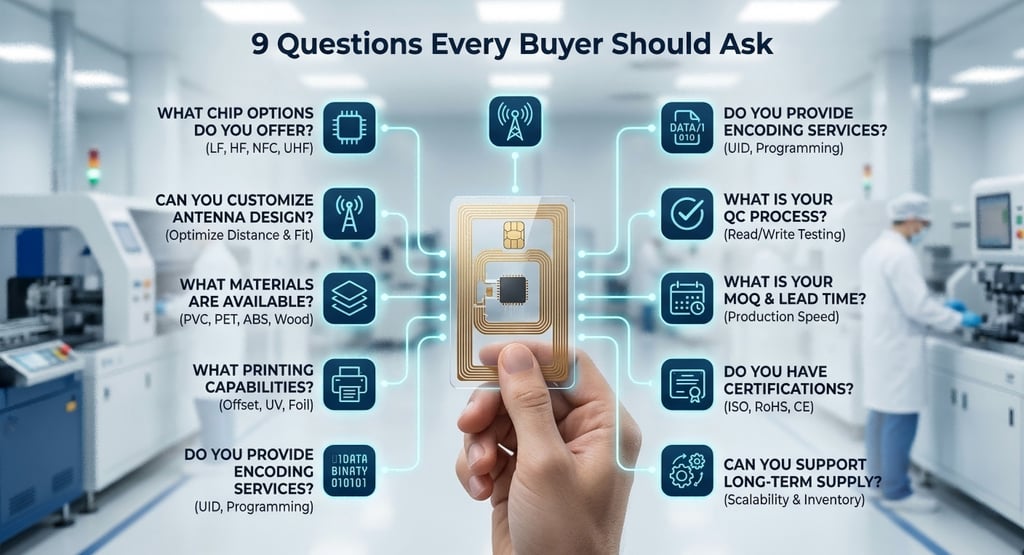
Introduction
Choosing the right RFID card manufacturer is not just about price — it directly affects your project stability, product lifespan, and long-term supply chain reliability.
Whether you are sourcing for access control, hotel key cards, transportation, or event management, a wrong supplier can lead to compatibility issues, inconsistent quality, or delivery delays.
Here are 9 essential questions every buyer should ask before placing an order.
1. What Chip Options Do You Offer?
A professional manufacturer should support a wide range of chips, such as:
Low Frequency (LF): TK4100, EM4200
High Frequency (HF): MIFARE Classic, Ultralight, DESFire
NFC: NTAG213/215/216
UHF: Alien, Impinj
Why it matters:
Different applications require different chips. A limited chip offering usually means limited technical capability.
2. Can You Customize Antenna Design?
A reliable OEM factory should be able to:
Adjust antenna size and layout
Optimize reading distance
Match specific reader environments
Red flag: Suppliers who only offer “standard templates”.
3. What Materials Are Available?
Common RFID card materials include:
PVC (most common)
PET / PETG (eco-friendly & durable)
ABS (industrial use)
Wooden / biodegradable materials
Tip:
If your project involves outdoor or industrial use, material selection is critical.
4. What Printing Capabilities Do You Have?
Check if the supplier supports:
Offset printing (high quality)
Silk screen printing
Metallic / gold foil
UV printing
Laser engraving
Why it matters:
Branding quality directly impacts your end-user perception.
5. Do You Provide Encoding & Data Services?
A qualified manufacturer should offer:
UID encoding
URL / NFC programming
Database matching
Variable QR/barcode printing
Value:
This saves you significant time and reduces post-processing errors.
6. What Is Your Quality Control Process?
Ask about:
Read/write testing
Frequency consistency checks
Surface inspection
Batch traceability
Professional factories will have multi-step QC, not random sampling only.
7. What Is Your MOQ and Lead Time?
Typical benchmarks:
MOQ: 500–1000 pcs (custom projects)
Sample lead time: 3–7 days
Mass production: 7–15 days
Watch out: Unrealistically short lead times often mean unstable production.
8. Do You Have Certifications?
Important certifications include:
ISO9001
RoHS
REACH
CE (depending on product type)
These are especially important for EU and US markets.
9. Can You Support Long-Term Supply?
This is often overlooked.
Ask:
Do you keep chip inventory?
Can you handle repeat orders consistently?
What happens if a chip is discontinued?
A good OEM partner thinks in years, not just one order.
Why Work Directly with an RFID OEM Factory?
Compared to trading companies, working with a factory gives you:
Better pricing control
Faster technical response
Customization flexibility
Stable production capacity
Conclusion
Selecting the right RFID card manufacturer is about reducing risk and ensuring scalability.
If your supplier cannot clearly answer the questions above, it’s a signal to reconsider.
Call to Action
Looking for a reliable RFID OEM partner?
👉 Contact us today to get a free consultation and sample solution tailored to your project.