
LF vs HF vs UHF RFID: What’s the Difference and Which One Should You Choose?
Learn the differences between LF, HF, and UHF RFID, including frequency, reading range, speed, and best use cases for access control, logistics, healthcare, and asset tracking.
RFID PRODUCTS GUIDESRFID BASICSRFID TECHNOLOGY
12/11/20254 min read
RFID technology is widely used in access control, asset tracking, logistics, healthcare, retail, animal identification, and many other industries. But one of the most common questions buyers ask is simple:
What is the difference between LF, HF, and UHF RFID?
Choosing the right RFID frequency is one of the most important decisions in any RFID project. If you choose the wrong type, you may face short reading distance, unstable performance, environmental interference, or unnecessary costs.
In this guide, we explain the differences between LF, HF, and UHF RFID and help you understand which one is best for your application.
What Is RFID Frequency?
RFID systems work by using radio waves to identify and track tagged objects. Different RFID products operate at different frequency bands, and each band has its own advantages, limitations, and ideal use cases.
The three most common RFID frequency types are:
LF RFID: Low Frequency
HF RFID: High Frequency
UHF RFID: Ultra-High Frequency
The right choice depends on your project requirements, including reading range, speed, environment, tag size, and cost.
1. LF RFID (Low Frequency)
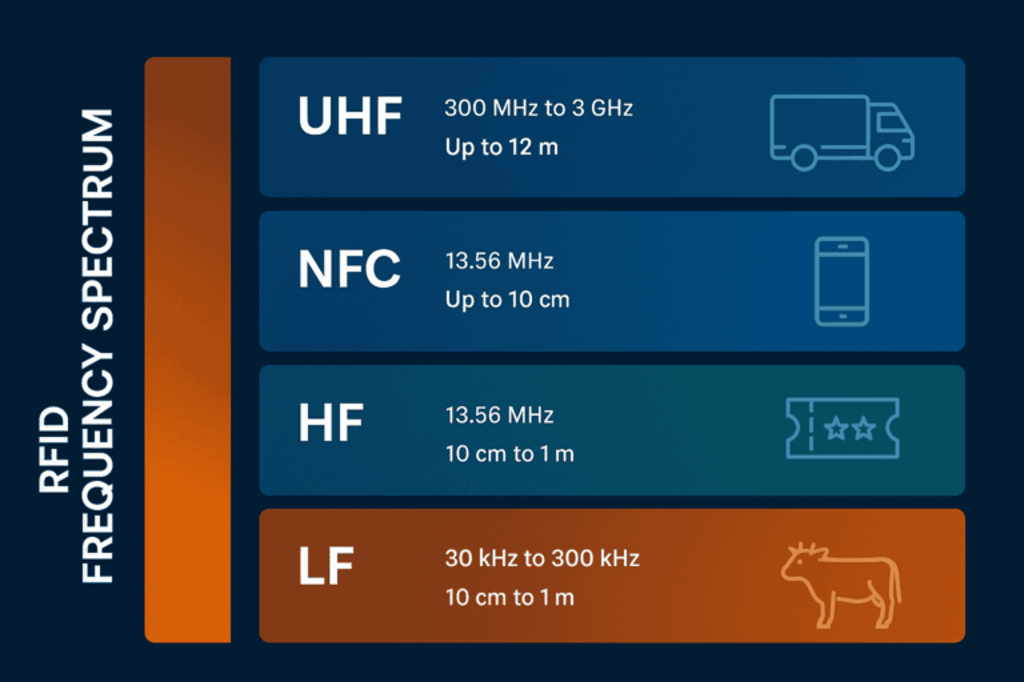
Frequency range: around 125 kHz or 134.2 kHz
LF RFID is known for its stable performance in harsh environments, especially where water, moisture, dirt, or animal tissue may affect signal transmission. It usually has a short reading distance, but it is reliable and widely used in identification applications.
Main advantages of LF RFID
Stable performance near water and organic materials
Good for harsh environments
Reliable for close-range identification
Common in animal identification and access control
Limitations of LF RFID
Short reading distance
Slower data transfer
Usually lower anti-collision performance than UHF
Common LF RFID applications
Animal identification
Pet microchips
Livestock management
Access control keyfobs
Industrial identification in dirty or wet environments
If your project requires close-range scanning and stable performance in difficult environments, LF RFID is often a good option.
2. HF RFID (High Frequency)
Frequency range: 13.56 MHz
HF RFID is one of the most widely used RFID types. It offers moderate reading range and strong compatibility with smart card and NFC applications. In fact, NFC is a subset of HF RFID.
HF RFID is commonly used for applications that need secure identification, controlled short-range reading, and smooth interaction with people.
Main advantages of HF RFID
Widely used and highly versatile
Supports NFC applications
Good for smart cards and user interaction
Suitable for access control, ticketing, payment, and identification
Short-to-medium reading range with stable performance
Limitations of HF RFID
Reading range is shorter than UHF
Less suitable for long-distance bulk reading
Speed may not match high-volume warehouse scanning needs
Common HF RFID applications
RFID cards
NFC business cards
Hotel key cards
Membership cards
Library systems
Ticketing systems
Cashless event wristbands
Healthcare identification
Campus cards
If your project involves smart cards, NFC products, user authentication, or close-range reading, HF RFID is often the best fit.
3. UHF RFID (Ultra-High Frequency)
Frequency range: typically 860–960 MHz
UHF RFID is the preferred option when you need longer reading distance, faster data transfer, and batch reading of multiple tags. It is widely used in logistics, warehousing, retail, industrial asset tracking, and supply chain management.
Main advantages of UHF RFID
Long reading range
Fast reading speed
Suitable for reading multiple tags at once
Ideal for logistics and inventory automation
Strong performance in asset tracking and industrial scenarios
Limitations of UHF RFID
Performance can be affected by metal and liquid
Requires proper tag selection and tuning
More sensitive to environmental factors than LF in some conditions
Common UHF RFID applications
Warehouse management
Inventory counting
Industrial asset tracking
Pallet and carton tracking
Retail stock control
Vehicle and equipment tracking
Supply chain visibility
If your project requires long-distance reading or fast bulk scanning, UHF RFID is usually the most efficient choice.
Quick Comparison: LF vs HF vs UHF RFID
LF RFID
Short reading range
Strong stability near water and organic materials
Best for animal ID and close-range access control
HF RFID
Medium reading range
Excellent for smart cards and NFC
Best for access control, hotels, events, healthcare, and interactive applications
UHF RFID
Long reading range
Fast and efficient multi-tag reading
Best for logistics, warehousing, retail, and asset tracking
How to Choose the Right RFID Frequency
When selecting RFID technology, ask the following questions:
1. What reading distance do you need?
Very short distance: LF or HF
Medium distance: HF
Long distance: UHF
2. What environment will the tag be used in?
Near water, moisture, or living tissue: LF often performs better
Standard smart card or NFC use: HF
Warehouse, logistics, and industrial inventory: UHF
3. Do you need mobile phone interaction?
If the product needs to work with smartphones, HF/NFC is usually the right choice.
4. Will you read one tag at a time or many tags at once?
Single close-range interaction: LF or HF
Bulk reading and automation: UHF
5. Will the tag be attached to metal?
For metal surfaces, standard tags may not work well. In this case, you may need anti-metal RFID tags, especially in UHF projects.
Typical Frequency Recommendations by Industry
Access Control & Security
HF RFID or LF RFID, depending on system compatibility
Hospitality & Hotels
HF RFID for hotel key cards and guest identification
Events & Cashless
HF RFID and NFC for wristbands, payments, and ticketing
Retail & Inventory
UHF RFID for stock visibility and item tracking
Logistics & Supply Chain
UHF RFID for cartons, pallets, and warehouse movement
Healthcare & Medical
HF RFID for patient identification and wristbands
Animal Identification & Agriculture
LF RFID for reliable close-range identification
Industrial Asset Tracking
UHF RFID or anti-metal UHF tags for equipment and tools
Why Frequency Selection Matters
A successful RFID project is not only about buying tags. It is about matching the correct frequency, chip type, material, form factor, and application environment.
For example:
A hotel key card project usually works best with HF RFID
A livestock identification project often requires LF RFID
A warehouse asset tracking solution usually depends on UHF RFID
A metal equipment tracking project may need UHF anti-metal tags
That is why many buyers choose custom RFID products instead of standard generic tags.
Need Help Choosing the Right RFID Product?
At China Smart Card, we provide custom RFID cards, NFC products, wristbands, keyfobs, tags, and labels for different industries and application environments.
We can help with:
Frequency selection
Chip recommendations
Material suggestions
Printing and personalization
Anti-metal solutions
Prototyping and custom development
If you are planning an RFID project and are not sure which frequency is right for you, feel free to contact us for technical support and product recommendations.