
RFID OEM/ODM Process Explained: From Requirement to Mass Production
Understand the full RFID OEM/ODM process from concept to mass production. Learn how to reduce risks and speed up your custom RFID project.
OEM RFID GUIDE
3/11/20261 min read
Introduction
Many buyers hesitate to start a custom RFID project because the process seems complex.
In reality, a professional RFID OEM factory follows a clear, structured workflow — and understanding it helps you save time, reduce costs, and avoid common mistakes.
Here is a complete breakdown of the RFID OEM/ODM process.
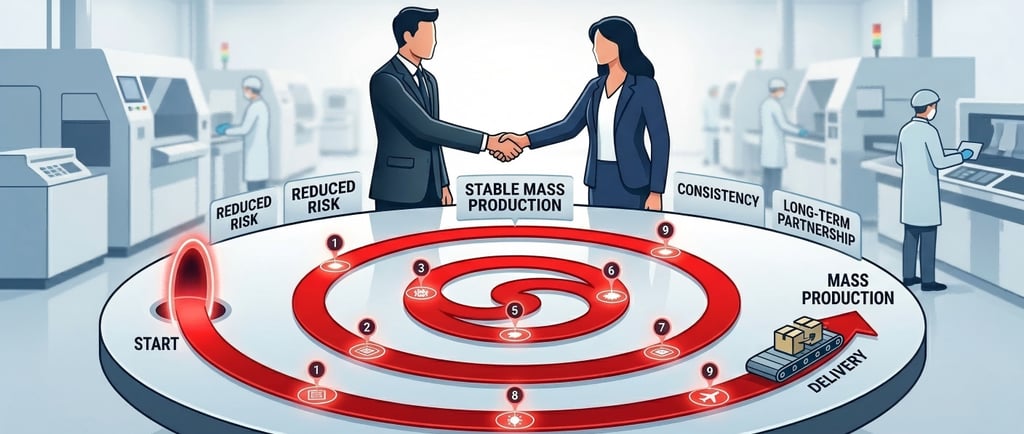
Step 1: Requirement Confirmation
Everything starts with defining:
Application scenario (access control, payment, tracking, etc.)
Frequency (LF / HF / UHF)
Reading distance
Product type (card, wristband, tag, keyfob)
Quantity and budget
Tip:
The more precise your requirements, the faster the project moves.
Step 2: Chip & Antenna Selection
Based on your needs, the manufacturer will:
Recommend suitable chip models
Design or adjust antenna structure
Optimize performance for your environment
This step directly determines product performance.
Step 3: Design & Artwork Confirmation
This includes:
Card layout / logo / branding
Printing method selection
Special finishes (foil, UV, embossing)
A digital mockup is usually provided for approval.
Step 4: Sampling (Prototype Production)
Before mass production, samples are made to verify:
Reading performance
Printing quality
Structural durability
Typical timeline: 3–7 days
Step 5: Testing & Validation
Professional factories conduct:
Read/write testing
Environmental testing (heat, humidity)
Durability tests
Clients may also test samples with their own systems.
Step 6: Mass Production
Once samples are approved:
Materials are prepared
Production lines are scheduled
Batch production begins
Key point:
Consistency is more important than speed.
Step 7: Encoding & Personalization
If required, the factory will:
Encode chips (UID / URL / data)
Print serial numbers / QR codes
Match database records
Step 8: Quality Control & Packaging
Before shipment:
100% or sampling inspection
Packaging customization (boxes, labels)
Export-ready packing
Step 9: Logistics & Delivery
Options include:
Express (DHL / FedEx / UPS)
Air freight
Sea freight
Lead time depends on quantity and destination.
Common Mistakes to Avoid
Choosing chip only based on price
Ignoring testing phase
Not confirming encoding format
Underestimating lead time
Why a Structured OEM Process Matters
A clear process ensures:
Predictable delivery
Stable quality
Lower defect rates
Better long-term cooperation
Conclusion
RFID OEM is not complicated — if you work with the right partner.
Understanding the process helps you control risks and accelerate your project timeline.
Call to Action
Have a custom RFID project in mind?
👉 Send us your requirements and get a professional solution within 24 hours.